Acknowledgements
This project is part of the CS 188 projects created by John DeNero, Dan Klein, Pieter Abbeel, and many others.
Project 2: Multi-Agent Pacman
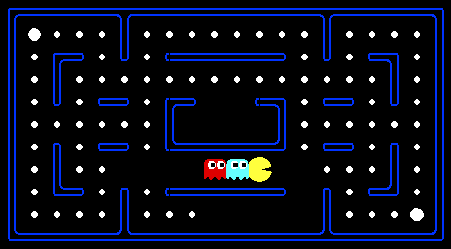
Pacman, now with ghosts.
Minimax, Expectimax,
Evaluation.
Introduction
In this project, you will design agents for the classic version of Pacman, including ghosts. Along the way, you will implement both minimax and expectimax search and try your hand at evaluation function design.
The code base has not changed much from the previous project, but please
start with a fresh installation, rather than intermingling files from
project 1. You can, however, use your search.py
and searchAgents.py in
any way you want.
The code for this project including the autograder is available as a zip archive.
Key files to read
multiAgents.py |
Where all of your multi-agent search agents will reside. |
pacman.py |
The main file that runs Pacman games. This file also describes a
Pacman GameState type, which you will use extensively
in this project |
game.py |
The logic behind how the Pacman world works. This file describes several supporting types like AgentState, Agent, Direction, and Grid. |
util.py |
Useful data structures for implementing search algorithms. |
Files you can ignore
graphicsDisplay.py |
Graphics for Pacman |
graphicsUtils.py |
Support for Pacman graphics |
textDisplay.py |
ASCII graphics for Pacman |
ghostAgents.py |
Agents to control ghosts |
keyboardAgents.py |
Keyboard interfaces to control Pacman |
layout.py |
Code for reading layout files and storing their contents |
What to submit: You will fill in portions of
multiAgents.py
during the assignment. You should submit this file with your code and
comments. You may also submit supporting files (like
search.py,
etc.) that you use in your code. Please do not change the other
files in this distribution or submit any of our original files other than
multiAgents.py. Directions
for submitting are on the course website.
Evaluation: Your code will be autograded for technical correctness. Please do not change the names of any provided functions or classes within the code, or you will wreak havoc on the autograder. However, the correctness of your implementation -- not the autograder's judgements -- will be the final judge of your score. If necessary, we will review and grade assignments individually to ensure that you receive due credit for your work.
Academic Dishonesty: We will be checking your code against other submissions in the class for logical redundancy. If you copy someone else's code and submit it with minor changes, we will know. These cheat detectors are quite hard to fool, so please don't try. We trust you all to submit your own work only; please don't let us down. If you do, we will pursue the strongest consequences available to us.
Getting Help: You are not alone! If you find yourself stuck on something, contact the TAs for help. Office hours and piazza are there for your support; please use them. If you can't make our office hours, let us know and we will schedule more. We want these projects to be rewarding and instructional, not frustrating and demoralizing. But, we don't know when or how to help unless you ask. And please do not wait until the last minute to ask questions.
Multi-Agent Pacman
First, play a game of classic Pacman:
python pacman.pyNow, run the provided
ReflexAgent in
multiAgents.py:
python pacman.py -p ReflexAgentNote that it plays quite poorly even on simple layouts:
python pacman.py -p ReflexAgent -l testClassicInspect its code (in
multiAgents.py)
and make sure you understand what it's doing.
Question 1 (3 points) Improve the ReflexAgent
in multiAgents.py to
play respectably. The provided reflex agent code provides some helpful
examples of methods that query the GameState for
information. A capable reflex agent will have to consider both food
locations and ghost locations to perform well. Your agent should easily
and reliably clear the testClassic layout:
python pacman.py -p ReflexAgent -l testClassicTry out your reflex agent on the default
mediumClassic layout
with one ghost or two (and animation off to speed up the display):
python pacman.py --frameTime 0 -p ReflexAgent -k 1
python pacman.py --frameTime 0 -p ReflexAgent -k 2How does your agent fare? It will likely often die with 2 ghosts on the default board, unless your evaluation function is quite good.
Note: you can never have more ghosts than the layout permits.
Note: As features, try the reciprocal of important values (such as distance to food) rather than just the values themselves.
Note: The evaluation function you're writing is evaluating state-action pairs; in later parts of the project, you'll be evaluating states.
Options: Default ghosts are random; you can also play for fun
with slightly smarter directional ghosts using -g DirectionalGhost.
If the randomness is preventing you from telling whether your agent is
improving, you can use -f to run with a fixed random seed
(same random choices every game). You can also play multiple games in a
row with -n. Turn off graphics with -q to run
lots of games quickly.
Grading: we will run your agent on the openClassic
layout 10 times. You will receive 0 points if your agent times out, or
never wins. You will receive 1 point if your agent wins at least 5 times.
You will receive an addition 1 point if your agent's average score is
greater than 500, or 2 points if it is greater than 1000. You can try your
agent out under these conditions with
python pacman.py -p ReflexAgent -l openClassic -n 10 -q
Don't spend too much time on this question, though, as the meat of the project lies ahead.
Question 2 (4 points) Now you will write an
adversarial search agent in the provided MinimaxAgent class
stub in multiAgents.py.
Your minimax agent should work with any number of ghosts, so you'll have
to write an algorithm that is slightly more general than what appears in
the textbook. In particular, your minimax tree will have multiple min
layers (one for each ghost) for every max layer.
Your code should also expand the game tree to an arbitrary depth. Score
the leaves of your minimax tree with the supplied self.evaluationFunction,
which defaults to scoreEvaluationFunction. MinimaxAgent
extends MultiAgentAgent, which gives access to self.depth
and self.evaluationFunction. Make sure your minimax code
makes reference to these two variables where appropriate as these
variables are populated in response to command line options.
Important: A single search ply is considered to be one Pacman move and all the ghosts' responses, so depth 2 search will involve Pacman and each ghost moving two times.
Grading: We will be checking your code to determine whether it
explores the correct number of game states. This is the only way reliable
way to detect some very subtle bugs in implementations of minimax. As a
result, the autograder will be very picky about how many times
you call GameState.getLegalActions. If you call it any more
or less than necessary, the autograder will complain. Note, however, that
the autograder will accept solutions both with and without the Directions.STOP
action available.
Hints and Observations
- The evaluation function in this part is already written (
self.evaluationFunction). You shouldn't change this function, but recognize that now we're evaluating *states* rather than actions, as we were for the reflex agent. Look-ahead agents evaluate future states whereas reflex agents evaluate actions from the current state. - The minimax values of the initial state in the
minimaxClassiclayout are 9, 8, 7, -492 for depths 1, 2, 3 and 4 respectively. Note that your minimax agent will often win (665/1000 games for us) despite the dire prediction of depth 4 minimax.python pacman.py -p MinimaxAgent -l minimaxClassic -a depth=4
- To increase the search depth achievable by your agent, remove the
Directions.STOPaction from Pacman's list of possible actions. Depth 2 should be pretty quick, but depth 3 or 4 will be slow. Don't worry, the next question will speed up the search somewhat. - Pacman is always agent 0, and the agents move in order of increasing agent index.
- All states in minimax should be
GameStates, either passed in togetActionor generated viaGameState.generateSuccessor. In this project, you will not be abstracting to simplified states. - On larger boards such as
openClassicandmediumClassic(the default), you'll find Pacman to be good at not dying, but quite bad at winning. He'll often thrash around without making progress. He might even thrash around right next to a dot without eating it because he doesn't know where he'd go after eating that dot. Don't worry if you see this behavior, question 5 will clean up all of these issues. - When Pacman believes that his death is unavoidable, he will try to end
the game as soon as possible because of the constant penalty for living.
Sometimes, this is the wrong thing to do with random ghosts, but minimax
agents always assume the worst:
python pacman.py -p MinimaxAgent -l trappedClassic -a depth=3
Make sure you understand why Pacman rushes the closest ghost in this case.
Question 3 (4 points) Make a new agent that
uses alpha-beta pruning to more efficiently explore the minimax tree, in
AlphaBetaAgent.
Again, your algorithm will be slightly more general than the pseudo-code
in the textbook, so part of the challenge is to extend the alpha-beta
pruning logic appropriately to multiple minimizer agents.
You should see a speed-up (perhaps depth 3 alpha-beta will run as fast
as depth 2 minimax). Ideally, depth 3 on smallClassic should
run in just a few seconds per move or faster.
python pacman.py -p AlphaBetaAgent -a depth=3 -l smallClassic
The AlphaBetaAgent minimax values should be identical to
the MinimaxAgent minimax values, although the actions it
selects can vary because of different tie-breaking behavior. Again, the
minimax values of the initial state in the minimaxClassic
layout are 9, 8, 7 and -492 for depths 1, 2, 3 and 4 respectively.
Grading: Because we check your code to determine whether it
explores the correct number of states, it is important that you perform
alpha-beta pruning without reordering children.
In other words, successor states should always be processed in the order
returned by GameState.getLegalActions
Question 4 (4 points)
Random ghosts are of course not optimal minimax agents, and so modeling
them with minimax search may not be appropriate. Fill in ExpectimaxAgent,
where your agent
agent will no longer take the min over all ghost actions, but the
expectation according to your agent's model of how the ghosts
act. To simplify your code, assume you will only be running against RandomGhost
ghosts, which choose amongst their
getLegalActions uniformly at random.
You should now observe a more cavalier approach in close quarters with ghosts. In particular, if Pacman perceives that he could be trapped but might escape to grab a few more pieces of food, he'll at least try. Investigate the results of these two scenarios:
python pacman.py -p AlphaBetaAgent -l trappedClassic -a depth=3 -q -n 10
python pacman.py -p ExpectimaxAgent -l trappedClassic -a depth=3 -q -n 10You should find that your
ExpectimaxAgent wins about half the
time, while your AlphaBetaAgent always loses. Make sure you
understand why the behavior here differs from the minimax case.
Question 5 (5 points) Write a better
evaluation function for pacman in the provided function
betterEvaluationFunction. The evaluation function should
evaluate states, rather than actions like your reflex agent evaluation
function did. You may use any tools at your disposal for evaluation,
including your search code from the last project. With depth 2 search,
your evaluation function should clear the smallClassic
layout with two random ghosts more than half the time and still run at a
reasonable rate (to get full credit, Pacman should be averaging around
1000 points when he's winning).
python pacman.py -l smallClassic -p ExpectimaxAgent -a evalFn=better -q -n 10
Document your evaluation function! We're very curious about what great ideas you have, so don't be shy. We reserve the right to reward bonus points for clever solutions and show demonstrations in class.
Grading: we will run your agent on the smallClassic layout
10 times. We will assign points to your evaluation function in the
following way:
- If you win at least once without timing out the autograder, you receive 2 points. Any agent not satisfying these criteria will receive 0 points.
- +1 for winning at least 5 times.
- +1 for an average score of at least 500, +2 for an average score of at least 1000 (including scores on lost games)
- The additional points for average score and computation time will only be awarded if you win at least 5 times.
Hints and Observations
- As for your reflex agent evaluation function, you may want to use the reciprocal of important values (such as distance to food) rather than the values themselves.
- One way you might want to write your evaluation function is to use a linear combination of features. That is, compute values for features about the state that you think are important, and then combine those features by multiplying them by different values and adding the results together. You might decide what to multiply each feature by based on how important you think it is.
Project 2 is done. Go Pacman!